
Saturday, January 3, 1948
THE DESERET NEWS
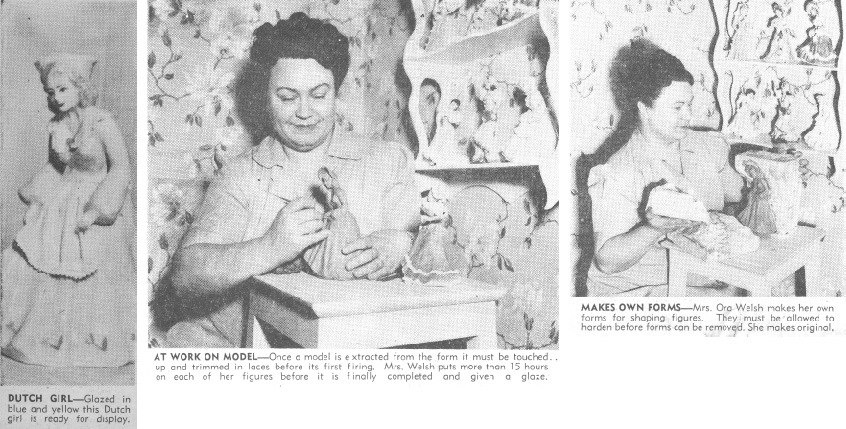
If you have the desire to create something artistic, you might like to hear of Mrs. Ora Welsh who is the mother of four healthy, husky boys, and still finds time to make ceramics.
Mrs. Welsh lives at 2653 Alden Street in Salt Lake, and has only been making the baked clay figurines for a couple of years. "I didn't even know I could do it until I tried," she said.
Ceramics are made of potter's clay, colored and baked at a high temperature, then glazed and baked again. The main difficulty encountered even by those gifted with the ability to shape these clay figures is that baking tones down the edges of painted lines and glazing re-moves much of the detail.
In a back room designed for her use by her husband, Mrs. Welsh spends spare hours every day working on tiny figures, pouring the liquid clay (slip) into forms and shaping delicate lace dress cuffs and blouses. She likes to do the molding and has made her own forms.
The first figure she made was a bathing beauty. When it turned out so successfully she was encouraged, and since that time has made scores of objects, many of which she gave to relatives for Christmas.
When working with a form, the first process is to make a liquid of the clay, then pour it into the form. Here it is allowed to harden before it is re-moved, touched up and painted for the first firing at about 2000 degrees. After the figures have been fired they are allowed to cool 24 hours, then sprayed for glazing. Each time they are fired they have to be allowed to cool for 24 hours or more.
Because Mrs. Welsh uses forms, don't get the idea that her figures are copies. The original figures are made by her also. She then makes forms out of plaster of paris for future use. "It speeds up the process," she said.
Can Be Changed
After the figures are taken from the forms they can be changed by altering their position, style of clothes and hats. Lace adornments are made by soaking real lace in the liquid clay and attaching it to the figures in the desired pattern. If this is heated at an uneven temperature or too high a temperature the lace melts and spoils the lace effect. Mrs. Welsh has her figures baked by a ceramic company.
From one form which Mrs. Welsh has made, a Dutch girl, a Spanish dancer and a variety of formally attired ladies have been shaped. It takes about 15 to 20 hours for each figure, Mrs. Welsh estimates.
The finished ceramic is usually about one-tenth smaller than the original clay model, because it shrinks with baking. Then there is also a color problem to be considered. Under the extreme heat, colors that appear to be the same before making may turn out entirely ditferent when extracted from the kiln (baking oven). This makes it necessary to paint dancing partners or other pairs of figures from the same paints, otherwise they may not match after the heat process.
Has Full Day
Four boys can take up a lot of time, and with ceramics as a hobby, Mrs.
Welsh has a full day every day. During the holidays she has been kept busy
cleaning up the house, preparing huge lunches and trying to keep order in
the household. However, the boys are taking a definite interest in her art.
Tuesday, March 16, 1948
SALT LAKE TELEGRAM
[the photos below were the only ones featuring Ora in a series of six illustrative photos.]
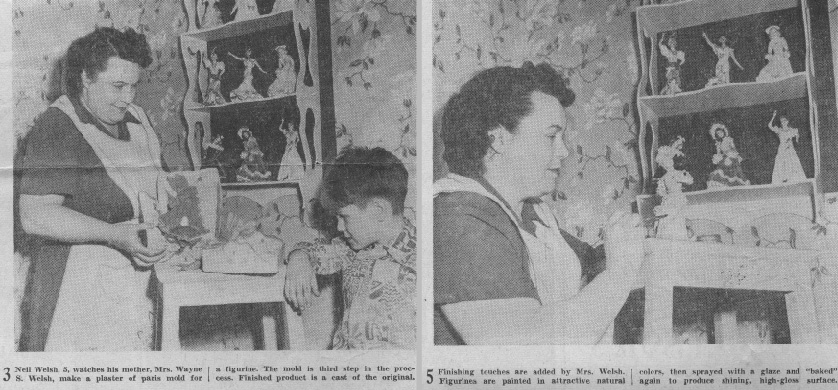
Salt Lakers are going in for ceramics making as a hobby--and in a big way, too!
Hundreds of housewives with time on their hands are using it profitably to fashion the decorative figurines, book ends and "little finishing touches" which make any house a home.
And they're having fun at it, according to one hobbyist, who explained that she hardly knew of a woman who didn't love to tinker with clay, and make beautiful things out of it, explaining that "it must be a way of relaxation which recalls their mud pie making days."
Anyway, a lot of grown-up little girls are "mud pie making" these days, and a lot of men, too, are finding in the hobby a fascinating pastime and a wonderful creative outlet.
The hobby of ceramics or pottery making isn't just fashioning clay into something. It becomes the opening wedge that leads constantly into other interests. Those who fashion figurines must delve into the romance and history of costume; the vase fashioner must learn design and the theory of the rhythm and flow of line--and those who would make beautiful animal figures soon find themselves interested in nature, and in the study of bone and muscle structure.
The history of ceramics or pottery making is a fascinating one. The origin of the formation of vessels from clay is lost in antiquity, and was not the product of one nation or one people, but resulted from the necessity which arose for articles of domestic use when mankind emerged from savagery to barbarism and communal life was instituted.
The ancient Chinese, Japanese, Asiatic and Egyptian peoples were artists in the production of precious porcelain and enameled ware. The immense library of Nippon, formed of clay cones and tablets, reveals the history of their civilization from as early as 7000 B. C., and the Egyptians represent their god Ptah as having fashioned the egg of the world in clay as their story of the creation.
The potter's art has been interwoven with the romantic and turbulent history of the world since ancient times. The work of Asiatic ceramic artists was prize booty for the Roman conquerors, and formed much of the prized riches brought from the orient in the 17th and 18th centuries.
The hobbyist in ceramics can't help but be drawn into the fascinating background of color and life through which his hobby originated and grew.
And all you need, according to those who are deeply engrossed in it and
love it, to open up this world for yourself is a that hunk of clay, a free
evening-and a slight creative urge.